Article · Neptune
Pisces and Neptune: how something larger is present in our lives
The sign, its rulers, and the work that brings something larger to life in particular things
Pavel Medvedev · Published: · Updated:
Marina used to give concerts. Now she performs less often, and lessons have appeared in her schedule. During one of them, a student is learning a melody on the piano. For a long time, he stopped between two passages: he would finish the first, collect his thoughts, and only then begin the second. Today he manages to play them straight through. Marina asks him to repeat them and listens closely herself: where the music grows more tense, where it settles, which notes invite a gentler touch.
She is absorbed in what is happening. She wants to try another way, go back, listen again. This is how she once worked on her own performances. Now the student is at the piano, but music still engages her from within.
We might say that her former musical life continues in a new activity. That is true, but a more interesting question lies behind it. A concert was always only part of her musical life. Why did we assume that music had to fit entirely inside concerts?
That question is a good starting point for discussing Pisces and Neptune. Their meanings are so close that it is easy to mistake one for the other. If Pisces concerns the presence of something larger through something particular, and Neptune makes that larger thing present, where is the distinction between sign and planet? And why do we need another ruler here—Jupiter?
Music is larger than one concert

In this approach, a sign describes the arrangement of a situation: which relationships come to the foreground. A planet names a function carried out within that situation. This is one way to understand the distinction between the sign as an environment and the planet as an operator. The technical word “operator” simply refers here to what happens in our experience: we understand, choose, act, change the extent of our participation, and keep something present through different forms.
With Pisces, we are interested in how a particular expression relates to something larger that cannot be present in it in its entirety. The lesson contains Marina, a student, an instrument, and a few measures of music. But musical life does not end at this room and this hour. What happens in the room lets them participate in it.
A fair objection arises: every activity is part of something larger. A concert is part of musical life, breakfast part of a day, a letter part of a correspondence. Inclusion alone is not enough to find Pisces everywhere.
So it matters which relationship we are considering. A lesson can be described as completing a curriculum, a paid hour, a meeting between two people, or an exercise in hand coordination. Each description has its truth. In the environment of Pisces, we consider it as a particular way of participating in something larger than the lesson itself. The question is no longer only whether the student played the right notes. Through this activity, a person engages with music, which is much larger than any individual performance.
That larger thing need not be in the past. Nor must it be waiting for us in the future. Music exists now, but it cannot all be brought into the room and played in one lesson. “Not present in its entirety” is therefore more accurate than “not yet present.” “Yet” would promise that one day the whole will assemble before us. Participation does not require that.
The word “geometry” thus acquires a thoroughly human meaning. We distinguish a particular expression, a larger whole, and the relationship of participation between them. This lets us discuss how experience is arranged while retaining its living substance.
How two rulers shape one environment
In this model, Neptune is the principal ruler of Pisces, and Jupiter its minor ruler. Their roles help explain why the situation has this particular arrangement.
Neptune concerns the work through which something larger comes to life in something concrete: sustaining an existing expression, developing it, or finding or creating another. Jupiter adds the possibility of changing the scale of participation in that larger world. Through the functions of the two rulers, we identify the arrangement of the environment: the connection of particular expressions to the whole, and a variable extent of participation in it.
Here it is especially important to distinguish the basis of our description from what happens in an individual situation. The rulers' functions help explain Pisces' geometry. But naming the sign does not mean that every particular lesson has already done the work of developing participation in music. The environment establishes relationships within which that work can happen.
“The scale of participation” is more precise than simply “manifestation.” The latter might be taken to mean vividness, visibility, or the strength of an impression. Yet someone's musical life can expand without any publicity. They begin playing more often at home, find a partner to play with, or gain time to listen to complete works. Their participation grows even if hardly anyone knows about it.
The opposite is possible too. Once there were tours, a large class, and daily rehearsals. Now there are a few students and occasional evenings at the instrument. The scale has shrunk. But whether music is present in that life remains a separate question. Small participation can be alive; a large volume of activity can become a mechanical discharge of duties.
“Minor” here refers to Jupiter's role in shaping the environment. It does not mean that its work in a particular person's life must be weak or barely noticeable. The scale of participation can determine a great deal: how much time, how many people, opportunities, and ways of joining in are actually available.
Nor do the rulers enact a compulsory sequence: first Neptune does one thing, then Jupiter arrives and does another. Their functions explain the arrangement of the environment. Within it, we can consider any planet's work separately. Pisces does not perform all the Neptunian actions for a person, just as the existence of a music classroom does not mean that living musical work is taking place inside it.
What, then, does Neptune do?
Let us return to the lesson. Marina could simply point out a mistake, check the homework, and move on to the next exercise. But in the scene described, she herself is listening closely to the music. Its expression, tension, and changing mood draw her in. She asks the student to repeat the passage because she wants to hear with him what might be possible here.
Through this particular lesson, music is present in her life. But if we stop at that description, Neptune almost coincides with Pisces again. We have named the resulting relationship and left the work itself offstage. Music seems to have appeared in the lesson by itself, merely because an instrument and a student are there.
Marina is actually investing herself in what happens. She hears where the student is still reproducing notes mechanically, looks for an example he can understand, and suggests trying differently. She supports a successful attempt, returns to a difficult passage, and helps sustain attention. She spends effort on making the lesson a living participation in music.
Pisces establishes the relationship between this particular lesson and a musical life that the lesson does not encompass. Neptune does the work with the particular: Marina sustains and develops the student's playing as a way to live through music. That expression needs attention, exploration, and sometimes patient returns to what is not yet working.
It is easy to lose the distinction if we define Neptune as “a person understands that an activity belongs to their musical life.” That understanding is possible, but by itself it does not describe what is happening. Marina might explain her relationship to music perfectly well while having felt no involvement in lessons for a long time. Or she might be deeply engaged in musical work without once explaining what connects her earlier concerts to her present lessons.
Understanding lets us notice and explain the connection. We identify Neptune's function in the work through which music finds expression in what Marina and her student are doing and experiencing now. She need not name the connection before investing in its development.
Nor should Neptune become an inspector standing beside life to check whether the whole has survived. We do the checking when we analyze the example. Inside the example, Marina works on a few measures, helping music find a living expression in this student's playing. The presence of the whole through the particular is what she achieves through that work.
The idea of “bringing someone into music” is helpful if we keep its active meaning. Marina helps the student enter musical work: begin to listen, seek expression, and take part in what is happening. Together, they develop a concrete way of participating. Music enters their lives through the effort they put into giving it expression.
What exactly does she sustain and develop?
The particular is more than a ready-made container for something larger. People work on it so that it can express that larger thing. They sustain it, refine it, and help it grow; when necessary, they find or create another form.
Marina may notice that the usual exercise does not help the student hear the melody. She then selects another, plays alongside him, suggests beginning with a short passage, or changes the emphasis. She seeks a way for this particular person to enter music. New expressions of the same whole appear: another performance, another way of working on a piece, another participant in musical life.
Her own participation develops through this work too. The student hears differently, encounters different difficulties, and unexpectedly plays a familiar passage another way. Marina must find approaches her own performances never demanded. Her musical life gains a continuation that was not ready in advance and cannot be reduced to repeating the past.
Effort alone does not define Neptune. Someone can put enormous effort into discipline, schedules, or completing an assignment without mistakes. In our example, the function becomes clear through the direction of the work: Marina develops a particular performance as a way of participating in music. Completing an exercise and helping music come alive in a student's playing may be aspects of the same lesson, but we distinguish why its forms are chosen and improved.
Creating a new expression should not automatically be equated with increasing scale either. Marina may replace one unsuccessful exercise with another while keeping the same lesson length and the same participants. She has worked on how music is present, although the available extent of participation may not have expanded. Jupiter concerns the scale of that participation; Neptune concerns sustaining and developing the concrete expressions through which the whole comes to life.
Continuation can begin today
The story of fewer concerts clearly shows a change of form. Yet it can quietly narrow Neptune's whole meaning to preserving the past, as though someone must first lose something and then search for its remnants in a new life.
Our idea needs no such condition. Imagine Marina has never given concerts. She is only beginning to study music and feels for the first time that working on a short melody opens an entire world. She returns to playing, learns to listen closely, and seeks ways to express what she hears. She develops a particular activity through which something larger enters her life. No prior loss is necessary.
Alongside “continues to live,” then, we should keep “begins to be present.” These expressions describe the course and result of the work being done. In one case, a person sustains and develops a new expression of something they have already lived through. In the other, they create and learn particular expressions through which they enter, for the first time, something their life now becomes part of.
Presence need not take the form of outward activity. Marina might listen to a recording, return to a work in her thoughts, or hear it anew. Living work can happen in memory too. A lesson is convenient for storytelling because the activity is easy to see, not because only an activity with an external result counts as real participation.
“Meaningful” is not a necessary part of the definition either. Music may be infinitely dear to Marina. But its value and the work on its expressions are different aspects of experience. Neptune's question is not simply how much a person loves something. We are interested in how they sustain, develop, and create the particular things through which it comes to life.
When even the interest itself changes
We can now take another step. Music is larger than a concert. But perhaps musical life was itself one of Marina's ways of becoming deeply absorbed, searching, discovering, and feeling inspired.
Suppose she takes up gardening. Working with plants absorbs her: watching them change, waiting, trying to arrange the space differently. Gradually, the way she participates becomes recognizable. In music, she learned to listen attentively, return to subtle differences, and go beyond the first successful result. Now that capacity to live with deep interest finds another expression.
The subject has changed more than it did in the move from concerts to lessons. Yet a connection may remain at a broader level. We are now considering the capacity to become absorbed, for which music was one expression and gardening becomes another.
It is important to distinguish two movements here. We can broaden the idea with which we describe Marina's life, moving from musical activity to enthusiasm in general. That changes the scale of our examination. Or we can notice that her life itself has made more room for engaged participation: she has gained time, energy, and new activities. That changes the scale of her participation. The second directly reveals the Jupiter role discussed earlier.
For Neptune, what matters is the work on living expressions of this connection. A shared label is insufficient. It is easy to group music and gardening under “hobbies,” but that tells us nothing about Marina. Continuation appears where she develops the new activity as an expression of her way of becoming absorbed: investing attention, sustaining what she has begun, and finding new ways to express and live that enthusiasm.
There is therefore no compulsory ladder up which we must keep climbing toward ever more general words. We can consider musical life and understand the situation accurately enough. We can also recognize a broader connection. What matters is that recognizable human experience remains behind the widening formulation.
“There is no such thing as a former intelligence officer”
Some examples make “being brought into something” sound too voluntary and ceremonial—as though a person deliberately approaches a larger world to become part of it. Sometimes that larger world keeps finding its own insistent way into their life.
“There is no such thing as a former intelligence officer.” The saying suggests that service may end while participation in a certain world continues. The person notices connections differently, reads situations, handles information, and builds relationships in a particular way. The former job and assignment are gone, but daily decisions still bring into their life something they became part of.
This is an expressive image, not a literal rule for every biography. What interests us is the gap between an outward ending and an inward continuation of participation. A single skill does not carry the saying's full force. “Good at remembering faces” is much narrower than “still an intelligence officer,” even though the person has long been doing something else.
The example reveals another possibility of Neptune. A person need not consciously call their work a continuation of their former world. They may consider that chapter closed while still maintaining connections, developing familiar ways of making sense of events, and finding new uses for them. The work happens even if its connection to the whole remains unconscious.
The saying about former intelligence officers primarily shows the persistent presence of something larger. To see the operator's work itself, we have to unfold the saying into a person's actions: what they sustain, what they invest in, and what new expressions they create. The absence of a deliberate decision to “become an intelligence officer again” does not mean the work is absent.
“Whatever you assemble, it still comes out a machine gun”
This joke shows the same persistence more sharply. Assignments, materials, and stated goals change, yet the outcome expresses the same thing again. Different individual activities become ways for a shared underlying organization to enter life and keep working through them.
That larger thing may be a professional world, an acquired way of approaching tasks, or the way an organization operates. The point of the joke is that varied intentions do not erase the recognizable result: in every new undertaking, the old world finds expression.
This does not mean we must declare every repeated habit to be Neptune. A habit can be considered as a habit, a skill as a skill. The joke shows the recognizable presence of a wider world in a particular result. Neptune's work emerges when we see how a person sustains and develops concrete ways to express that world, investing in new undertakings through which it comes to life again.
The machine-gun example is also useful because it prevents us from making Neptune automatically kind, elevated, or redemptive. Music may be present through a person. So may an attitude to the world that turns every new undertaking into a familiar weapon. Sustaining and developing particular expressions of a whole guarantees neither benefit, nor freedom, nor that the continuation is wanted.
A person within something larger—and something larger within their life
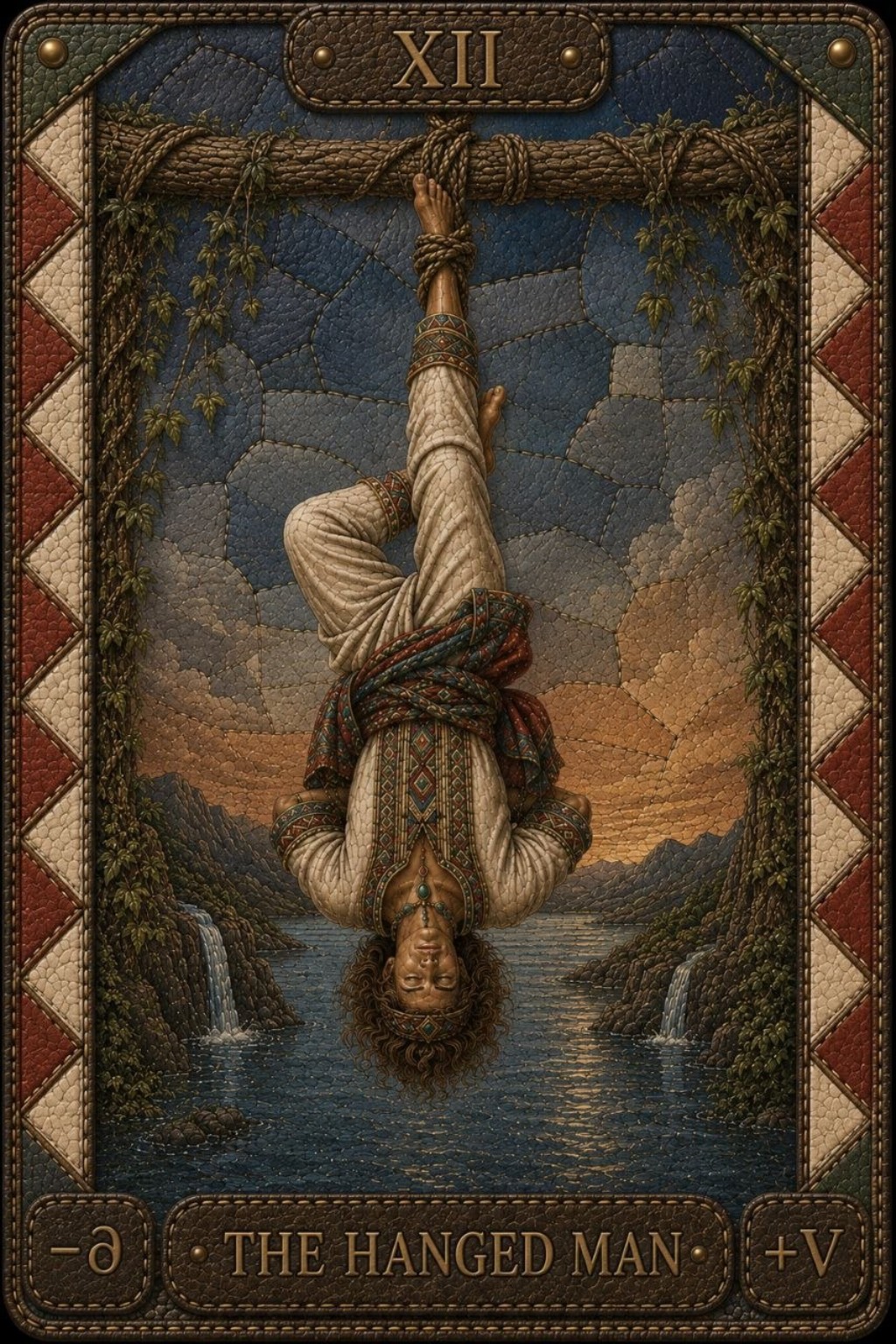
We can now return to the two cards. In the correspondences used here, the Moon stands for Pisces: the sign, the environment, the relationship of a particular expression to something it does not encompass. The card's name should not be confused with the Moon as a separate planetary function. The Hanged Man stands for Neptune: the work of sustaining, developing, and creating concrete expressions through which something larger can live, including when familiar ways of living change.
The rulers reveal the arrangement of the environment from two sides. Neptune's function lets us identify the connection between particular expressions and the whole; Jupiter's function identifies the variable scale of participation in what cannot be represented here in full. Pisces establishes this arrangement of participation. Neptune in Pisces does the work within it: sustaining, developing, and creating particular expressions so that something larger can live through them.
This distinguishes the environment, the work, and its result. A lesson can be a place of participation in music—that is how the situation is arranged. Marina invests attention and effort in her student's playing, helping it become a living expression of music—that is the work. Music becomes present in their shared lesson—that is what happens because of the work.
Marina sits beside her student. He plays the passage again, touching a few notes more gently. She hears the difference, asks him to return to the beginning, and forgets the clock for a while. There is no need to reassemble all her concerts, restore her old schedule, or prove that nothing was lost.
Right now, her life participates in music. Through her, music finds one more way to be present in the world.
In Marina's story, we can express the difference very briefly.
Pisces is music's presence in her life. Neptune in Pisces is her presence in the life of music.
She herself participates in how music lives on: investing attention and effort in her student's playing, sustaining and developing it, helping new performances and new participants emerge. Music has a place in her life, and her work gives music new ways to live.